
2026 will be the year that AI transforms from a shiny add-on to the operating system behind modern marketing. Many teams have already moved past experimentation and now rely on AI systems that influence planning, execution, and measurement every day.
The real shift is integrating AI + human workflows. Winning marketers don’t hand the keys to AI and hope for the best. They guide it, constrain it, and use it to amplify human judgment rather than replace it.
What follows are our predictions for how AI will reshape marketing over the next year.
Prediction 1: Search Shifts From Rankings to Answers
Search is evolving from a list of Google links to AI-generated answers. Gartner predicts that search engine volume will drop by 25% by 2026 as users migrate toward AI-generated summaries.
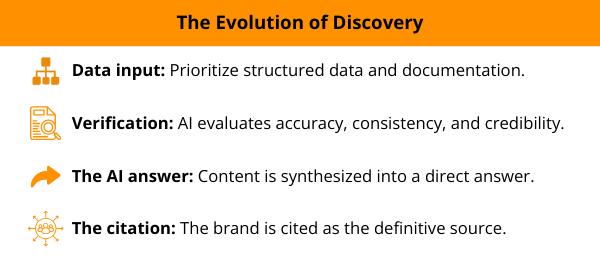
- The discovery pivot. Marketers will move from competing for blue links to becoming the definitive source within AI-generated summaries and direct answers.
- The new “source builder.” The most effective teams will prioritize structured data, comprehensive documentation, and clear answers instead of obsessing over keyword density.
- Citations as the premium. Being cited as a trusted reference by an LLM will become more valuable, and more difficult to earn, than raw click-through traffic.
- The death of “link building.” Traditional backlink strategies will fade as AI systems evaluate authority based on accuracy, consistency, and machine-readable credibility.
What this means for marketers
Marketers need to stop thinking like traffic hunters and start thinking like reference builders. The goal has changed from attracting more clicks to becoming the source AI trusts enough to quote.
Prediction 2: Campaigns Run Themselves While Marketers Run the System
AI moves beyond task assistance and begins managing entire campaign lifecycles at machine speed.
- The operational pivot. Marketers will shift from manual budget tweaks and daily optimizations to defining objectives, guardrails, and strategic constraints.
- The “AI buyer” liaison. New specialists will focus on making brand data easily interpretable by the AI agents procurement teams now use to evaluate vendors.
- System design as the premium. The ability to architect autonomous systems that scale without drifting off strategy will become a core competitive advantage.
- The exit of the “campaign executor.” Routine roles centered on manual A/B testing and daily optimization will be absorbed by platform-native AI.
What this means for marketers
The value shifts to marketers who can design systems that scale.
Prediction 3: Image and Video Creation Becomes Instant and Unlimited
Visual quality becomes table stakes.
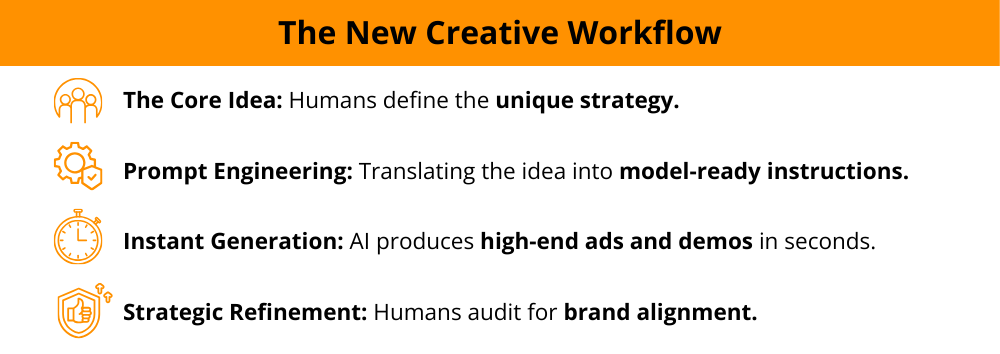
- The production pivot. Brands will move from expensive video shoots or stock photo libraries to prompt-driven generation of ads, demos, and social content.
- The “creative prompter.” New creative roles will focus on prompting AI toward creating visuals that feel intentional and on-brand.
- Creativity will be the premium. As photos become instant and free, the strength of the idea behind the creative becomes the real differentiator.
- The loss of “production quality” as a moat. High-end visuals will no longer protect brands from competition, forcing ideas to do the work.
What this means for marketers
Speed and polish are no longer advantages. Creative strategy matters more than ever when execution is effortless.
Prediction 4: Marketing Roles Shift Toward Strategy and System Design
Technical barriers continue to fall.
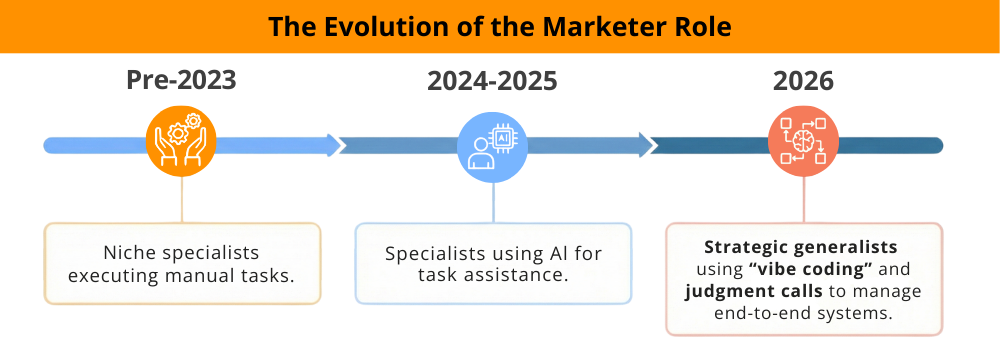
- The implementation pivot. Natural-language interfaces and “vibe coding” will replace traditional coding as the primary way marketers build tools, automations, and experiments.
- The “strategic generalist.” More marketers will use AI to bridge copy, design, and operations, executing full initiatives independently.
- Judgment calls as the premium. Evaluating AI output for brand alignment and strategic fit becomes more valuable than producing content.
- The disappearance of “niche specialists.” Roles focused on narrow execution tasks will fold into AI-assisted workflows.
What this means for marketers
Career value moves up the stack. Those who can connect strategy, systems, and taste will replace those who only execute instructions.
Prediction 5: Marketing Analytics Moves From Attribution to Oversight
Perfect visibility disappears as discovery moves inside AI systems.
- The measurement pivot. Teams will shift from chasing exact attribution to managing patterns, forecasts, and directional confidence.
- The “algorithm auditor.” Analysts will focus on detecting model drift, data decay, and misalignment between optimization and business outcomes.
- Human intuition as the premium. Knowing when to override an algorithm becomes a core skill.
- The retirement of “perfect attribution.” Single-source-of-truth dashboards quietly fade as journeys grow opaque.
What this means for marketers
Analytics becomes less about proof and more about judgment. Comfort with ambiguity becomes a competitive advantage.

Prediction 6: Authenticity Matters More Than Ever
Synthetic content floods the market, and audiences adapt quickly.
- The rising bar. Readers are already experiencing “AI slop” fatigue. When anyone can produce and publish 1000 words on a topic in 5 minutes, only those who offer originality and high-quality research will stand out.
- Quality over quantity. Brands will shift from high-volume, passable content to fewer, deeper pieces rooted in real expertise.
- Original research as the new standard. People will be hungry for primary-source content that tells a unique story.
- The “visible human.” Featuring real people, real thinking, and occasional imperfection becomes a trust signal.
- Specific opinion as the premium. Clear points of view cut through the bland consensus of AI-generated content.
- The erosion of “generic professionalism.” Polished but empty language becomes an immediate credibility killer.
What this means for marketers
Safe content is risky. Specificity and perspective are what signal real value in a crowded landscape.

Prediction 7: Marketing Teams Shrink, but Impact Grows
The org chart changes shape.
- The structural pivot. Large execution teams are replaced by lean, high-leverage groups of marketer–product managers.
- The new skillset. “AI workflow architects” design custom automations using low-code and vibe-coded tools.
- Editorial judgment as the premium. Taste, restraint, and strategic oversight become the most valuable skills in the room.
- Role disappearance. Production-only positions quietly exit as AI handles repetitive work.
What this means for marketers
Smaller teams are sharper. Impact grows with smart advantages, not headcount.
Prediction 8: Brand Voice Becomes a System, Not a Style Guide
Brand consistency moves from documents to infrastructure.
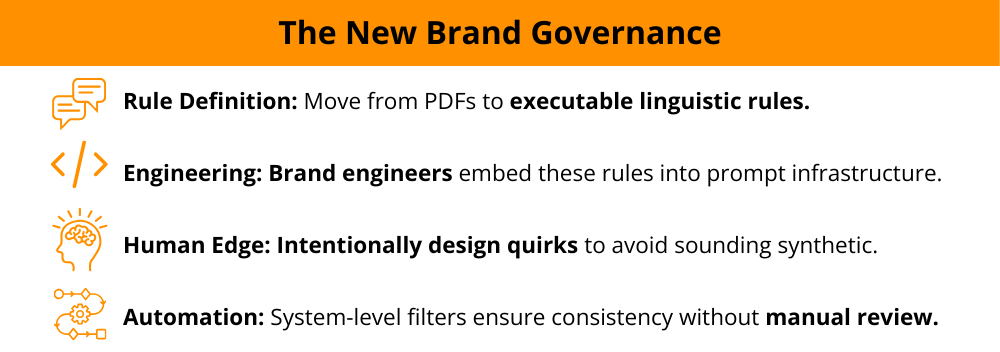
- The governance pivot. Static PDFs give way to executable linguistic rules embedded into AI prompts.
- The “brand engineer.” Teams tune prompts and filters to protect brand voice at scale.
- Intentional imperfection as the premium. Designed quirks and human edges prevent brands from sounding synthetic.
- The obsolescence of manual review. Control shifts from checking outputs to designing systems that prevent mistakes.
What this means for marketers
Brand stewardship becomes both creative and technical. Voice is engineered rather than enforced.
Prediction 9: The Spam Explosion and the Fight for Real Attention
Content volume explodes. Attention gets selective.
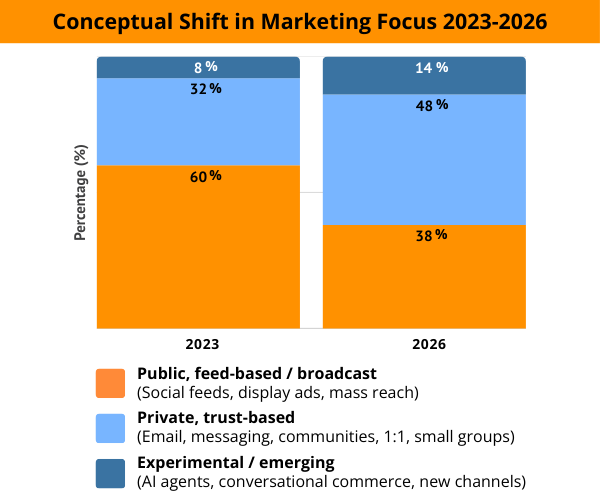
- The volume pivot. Brands retreat from public feed saturation and invest in private, trust-based channels.
- The new skillset. “Humanity verifiers” specialize in creating content that can’t be mass-produced or faked.
- Trust as the premium. Belief becomes the scarcest and most valuable currency.
- The death of cold outreach. Generic cold emails and mass tagging collapse under aggressive AI filters.
What this means for marketers
Attention is earned, not extracted. Fewer messages, stronger relationships, better results.
Prediction 10: Content Shifts From “Reading” to “Doing”
Static content is losing its pull. Read-only blog posts will give way to interactive, AI-powered tools and micro-apps.
- The utility pivot: Brands will replace 2,000-word “how-to” guides with custom calculators, simulators, and interactive agents that solve the user’s problem on the spot.
- Low-code as the driver: Marketers will use “vibe coding” to build these tools in hours rather than months, making interactive utility a standard part of every content piece.
- Engagement as the premium: Time spent interacting with a tool will become a more important metric than page views or scroll depth.
What this means for marketers
The “Information Age” is over; the “Utility Age” has begun. To keep people on your site, you must provide a tool they can use, not just a story they can read.
Marketer Takeaways
It’s been a crazy year. If you’re like us, you’re both excited and exhausted by the frenetic pace at which AI is moving. It’s already everywhere in marketing, and access to the technology is no longer a differentiator.
Here are our takeaways as we move into 2026.
- The first-mover advantage window is closing. Everyone has ChatGPT, everyone can generate images and video, and everyone runs automated campaigns.
- Standards are changing. The marketers who thrive in 2026 will treat AI as a system to be designed, guided, and improved, with human judgment steering every major decision.
- Empathy still matters. You need to understand what customers actually care about, not just what data suggests.
- Judgment still matters. AI can generate options, and humans decide which direction serves the strategy.
- Context still matters. Algorithms optimize for patterns, and humans understand the bigger picture.
We predict that Media Shower’s AI marketing platform will help you stand out, whatever the future holds. Click here for a free trial.
Sources
Our 2026 predictions are based on market forecasts from leading research firms:
Gartner: Gartner Predicts Search Engine Volume Will Drop 25% by 2026 Due to AI Chatbots
Forrester (The Shift to Agentic/Private Interfaces): Predictions 2025: The Year AI Makes Or Breaks Everything
McKinsey (The Rise of Agentic AI): Why Agents are the Next Frontier of Generative AI